
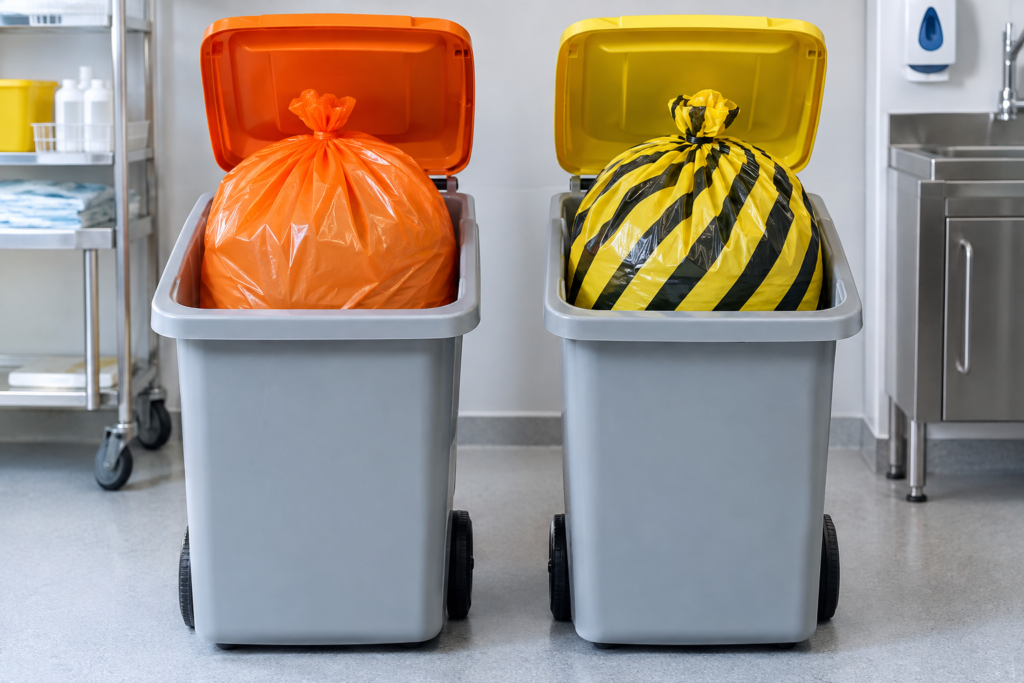
Learn the difference between orange sacks and tiger sacks. Discover what belongs in infectious clinical waste vs non-infectious offensive waste bags.
Orange Sacks vs Tiger Sacks: Infectious Clinical Waste Guide
If your business produces healthcare, hygiene, or clinical waste, understanding orange sacks vs tiger sacks is essential for maintaining full regulatory compliance. Although both types of waste sacks may be collected from the same premises, they are designed for entirely different waste streams and must never be used interchangeably.
The simplest way to remember the difference is:
- Orange sacks are for infectious clinical waste.
- Tiger sacks are for offensive, non-infectious waste.
Correct clinical waste segregation protects your staff, keeps your business compliant with UK waste regulations, and ensures that waste receives the appropriate treatment after collection.
What Are Orange Clinical Waste Sacks Used For?
Orange sacks are designated specifically for soft clinical waste that is infectious or considered likely to present a risk of infection to human health or the environment.
Examples of Infectious Waste for Orange Sacks
- Infectious wound dressings and bandages
- Swabs, wipes, and cotton rolls contaminated with infectious bodily fluids
- Disposable gloves, masks, and aprons used while treating someone with a known or suspected infection
- Infectious disposable Personal Protective Equipment (PPE)
- Other soft healthcare waste assessed as presenting an infection risk
The critical classification factor when evaluating orange sacks vs tiger sacks is the risk of infection, rather than simply the physical appearance of the item.
For example, the presence of a small trace of blood does not automatically mean that an item belongs in an orange sack. The correct classification depends on how the waste was produced, the clinical condition being treated, and whether an active or suspected infection risk exists.
What Must Not Go into an Orange Sack?
Orange clinical waste sacks are only intended for soft, infectious waste. To maintain workplace safety and prevent environmental contamination, they must not contain:
- Needles, scalpels, blades, or other sharp items (requires a yellow or orange sharps container)
- Unused medicines or pharmaceutical waste
- Hazardous chemicals or reagents
- Cytotoxic or cytostatic waste
- Anatomical waste or human tissue
- Free-flowing liquids or blood bags
- Aerosols, lithium batteries, or vapes
These hazardous items require specialized, rigid containers and dedicated disposal streams.
What Are Tiger Stripe Waste Bags Used For?
Tiger sacks (yellow bags with black stripes) are designed specifically for offensive or hygiene waste that is non-infectious.
The regulatory term “offensive waste” simply describes non-infectious waste that may be unpleasant because of its appearance, smell, or contents, but does not present a known infection risk.
Examples of Non-Infectious Waste for Tiger Sacks
- Used nappies and wet wipes
- Incontinence pads and sanitary products
- Non-infectious wound dressings and plasters
- Disposable PPE (gloves, aprons) with no infectious contamination
- Stoma or colostomy bags where no infection risk is identified
- Other non-infectious hygiene waste contaminated with non-infectious bodily fluids or secretions
Tiger stripe waste bags are frequently utilized by care homes, nurseries, schools, medical practices, beauty clinics, and commercial premises producing non-infectious hygiene waste.
What Must Not Go into a Tiger Sack?
To protect waste handling staff and maintain compliance, tiger stripe bags must not contain:
- Infectious clinical waste
- Needles, lancets, or other sharps
- Pharmaceuticals or leftover medicines
- Hazardous chemicals
- Anatomical waste
- Cytotoxic or cytostatic material
- Free-flowing liquids
- General recyclable materials (paper, cardboard, plastics)
Placing infectious waste into a tiger sack can expose collection operatives, recycling facility staff, and the general public to unnecessary biological risks and violate waste duty-of-care regulations.
Orange Sacks vs Tiger Sacks at a Glance
The comparative summary below highlights the primary differences when choosing between orange sacks and tiger stripe bags:
| Waste Bag Type | Primary Purpose | Key Contents Included | Prohibited Items |
| Orange Clinical Waste Sacks | Infectious clinical waste presenting a known or suspected risk | Infectious dressings, swabs, wipes, and contaminated PPE | Sharps, medicines, chemicals, liquids, recycling |
| Tiger Stripe Waste Bags | Non-infectious offensive and hygiene waste | Nappies, incontinence pads, non-infectious PPE, sanitary items | Infectious waste, sharps, medicines, chemicals, liquids |
Practical Example: Care Home Waste Assessment
An ordinary incontinence pad used by a resident with no known infection belongs in a tiger sack.
However, if that resident has a known or suspected infectious condition that could be transmitted via contaminated waste, a dedicated infectious waste stream using an orange sack is legally required.
This demonstrates why identical physical items do not always go into the same colored sack. The correct selection depends entirely on your risk assessment and local infection control protocols.
Why Is Correct Clinical Waste Segregation Important?
Some organisations routinely place all healthcare waste into orange sacks, assuming it is the safest option. However, treating non-infectious waste as infectious is incorrect practice and carries significant disadvantages.
Improper waste segregation can:
- Increase Waste Disposal Costs: Infectious waste treatment (such as alternative treatment plants or high-temperature incineration) costs significantly more than offensive waste processing.
- Waste Energy and Processing Capacity: Treating non-infectious items as hazardous uses unnecessary thermal and electrical energy.
- Fill Clinical Containers Prematurely: Overfilling containers leads to improper storage and potential spill hazards.
- Complicate Waste Audit Trails: Poor tracking makes it difficult to pass regulatory duty-of-care audits.
- Fail Inspections: Improper classification can result in warnings or fines during Environment Agency or local authority inspections.
Correct waste segregation ensures hazardous infectious waste is safely treated while keeping non-infectious offensive waste out of expensive clinical disposal streams.
How Should Filled Orange and Tiger Sacks Be Stored?
Orange and tiger sacks must remain clearly separated and identifiable throughout storage, handling, and collection.
When managing filled waste sacks, ensure they are:
- Securely Tied: Use a “swan-neck” tie or zip tie to prevent leakage.
- Labelled Correctly: Apply waste tracking labels where required by your carrier.
- Stored in Secure Containers: Keep sacks inside designated, lockable external wheelie bins.
- Protected: Keep waste safe from weather, animals, and unauthorised access.
- Collected by Licensed Carriers: Ensure your service provider holds a valid waste carrier license.
Safety Warning: Sacks must never be overfilled, manually compressed, or left loose outside bin enclosures. If a bag tears or leaks, follow your internal spill procedure and notify your waste service provider immediately.
How Often Should Orange and Tiger Sacks Be Collected?
Collection frequency depends on several operational factors:
- Total volume of waste produced
- On-site storage capacity
- Type of business or care environment
- Seasonal fluctuations in waste output
- Hygiene and odour considerations
- Workplace risk assessment recommendations
Collection schedules can range from weekly or fortnightly to four-weekly or on-demand service. A small dental clinic or tattoo studio will require a different schedule than a large residential care home or busy children’s nursery.
Frequently Asked Questions
Are tiger sacks classed as clinical waste?
No. Tiger sacks are used for non-infectious offensive or hygiene waste. Although the waste often originates from healthcare or care environments, it lacks the infectious properties that define hazardous clinical waste.
Can nappies go in orange clinical waste sacks?
Standard nappies with no identified infection risk should go into tiger sacks. An orange sack should only be used if an infection risk has been identified through a formal waste risk assessment.
Can gloves and aprons go in tiger sacks?
Yes, provided the disposable PPE is non-infectious. If the PPE was worn while treating an infectious patient or handling infectious material, it must go into an orange clinical waste sack.
Can orange sacks and tiger sacks be collected together?
Yes. Both waste streams can be collected from the same premises by the same licensed waste carrier, provided the sacks remain properly segregated, tagged, and contained in separate wheelie bins.
What should I do if I am unsure which sack to use?
Never guess. Check your organisation’s clinical waste policy or consult your licensed clinical waste provider. Waste should always be assessed and segregated at the point of production.
Professional Orange and Tiger Sack Collections in Cornwall and West Devon
Kernow Clinical Waste Ltd provides compliant orange clinical waste sack collections and tiger stripe waste collections across Cornwall and West Devon.
We help local businesses identify their required waste streams, supply UN-approved sacks and secure wheelie bins, issue complete Duty of Care waste transfer notes, and set up reliable collection schedules tailored to your operations.
As an independent, locally based waste provider, we deliver direct customer support—you can always speak directly to our team for clear guidance. Plus, 100% of the waste we collect is diverted from landfill.
If you are unsure whether your business waste belongs in an orange sack vs a tiger sack, contact our friendly team today.
- Phone: 01209 212545
- Email: sales@kernowclinical.co.uk
- Service Area: Cornwall and Devon
- www.kernowclinical.co.uk
- https://www.england.nhs.uk/publication/management-and-disposal-of-healthcare-waste-htm-07-01/


